

If you only read one line of this comparison, here it is: a lap desk is built for wherever you actually sit, and a laptop stand is built for a desk you already have. They both promise a more comfortable way to use your laptop, but they solve two different problems, and mixing them up is how a perfectly good product ends up unused in a closet a month after you bought it.
I've spent real time with both, not just a quick unboxing. I bought a basic laptop stand first because every article about home office comfort mentions one, and I mostly work at a proper desk. Then I picked up the SAIJI Laptop Bed Desk Table, which is really a lap desk with a small drawer built in, for the mornings and evenings when I want to answer emails from the couch or finish something in bed without hunching over a hot laptop resting directly on a blanket. Using both back to back made the actual difference between them obvious in a way that reading spec sheets never does.
A lot of people ask me this exact question after they've already bought the wrong one. They picked a laptop stand because it showed up in every best-of list, set it up on their nightstand or a couch-side tray table, and found it wobbling the moment they leaned on the keyboard. Or they bought a lap desk expecting it to fix neck strain at their main desk, and it didn't, because that was never the problem it was built to solve. Neither product failed them. They just answered a question nobody asked.
| What Matters | SAIJI Lap Desk | Laptop Stand |
|---|---|---|
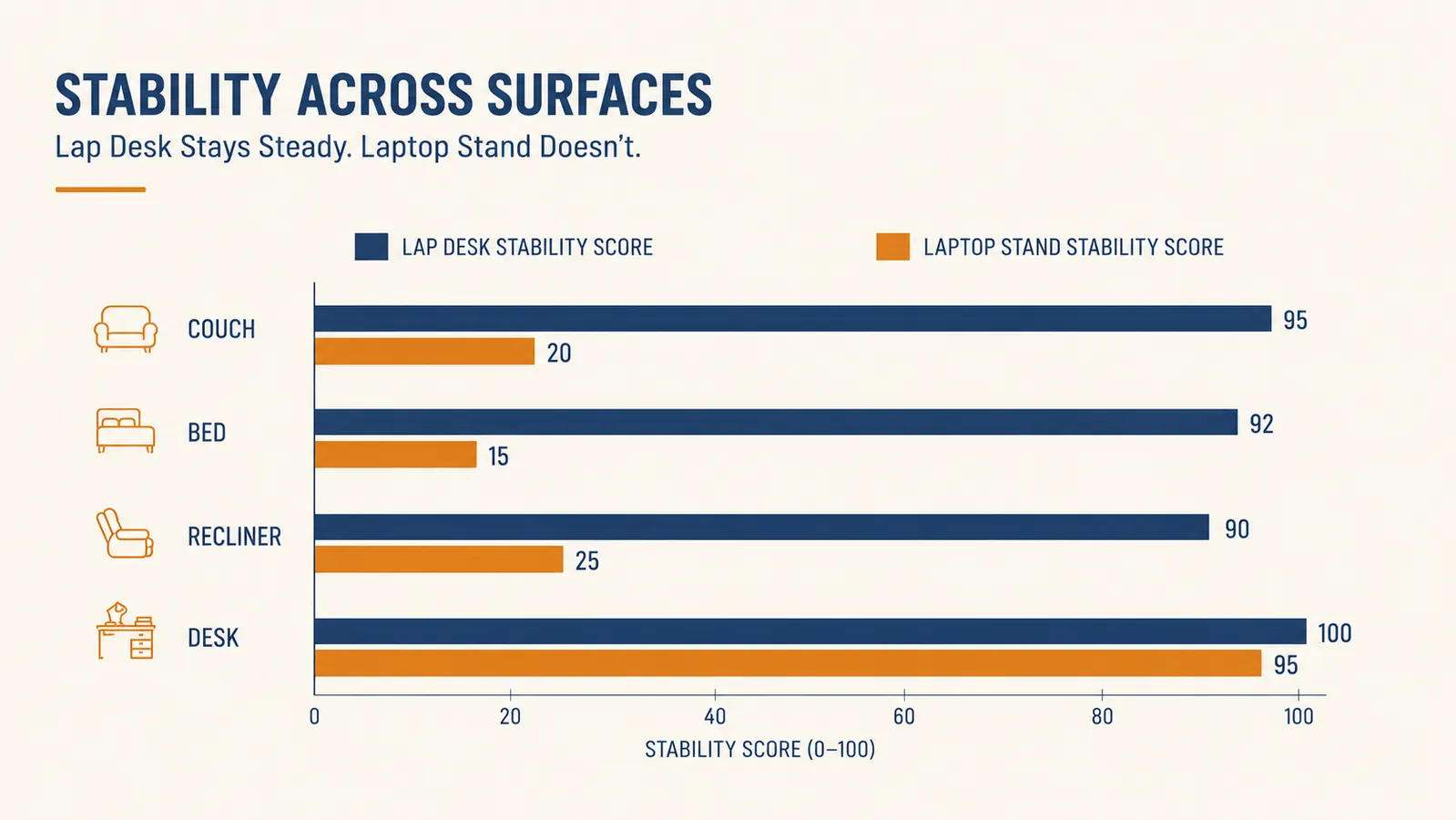
| Where You Can Use It | Works on a couch, bed, recliner, or any soft surface without shifting | Needs a flat, solid desk or table underneath to stay level |
| Stability | Wide flat top with a slight lip keeps the laptop from sliding off your knees | Small footprint frame can tip if bumped or set on anything uneven |
| Storage | Includes a small built-in drawer for a mouse, phone charger, or notepad | No storage at all, just a bare frame holding the laptop |
| Screen Height | Sits flat, so the screen stays at roughly the same height as the laptop's own hinge | Raises the laptop several inches, which genuinely helps neck position at a desk |
| Portability | Folds down reasonably flat and can move from room to room with you | Lightweight and often collapsible, but still needs a desk to be useful at all |
| Cost | Around today's price for a lap desk with storage built in | Often cheaper for a basic stand, more once you add a real ergonomic one |
| Best Use | Meant for casual, reclined, or off-desk work sessions | Meant for focused desk work where posture and screen height matter most |
| Heat and Ventilation | Vented top plus lift off your legs keeps a laptop from overheating on soft surfaces | Open frame design cools well, but only matters on a desk where it's already fine |
Where the Lap Desk Wins
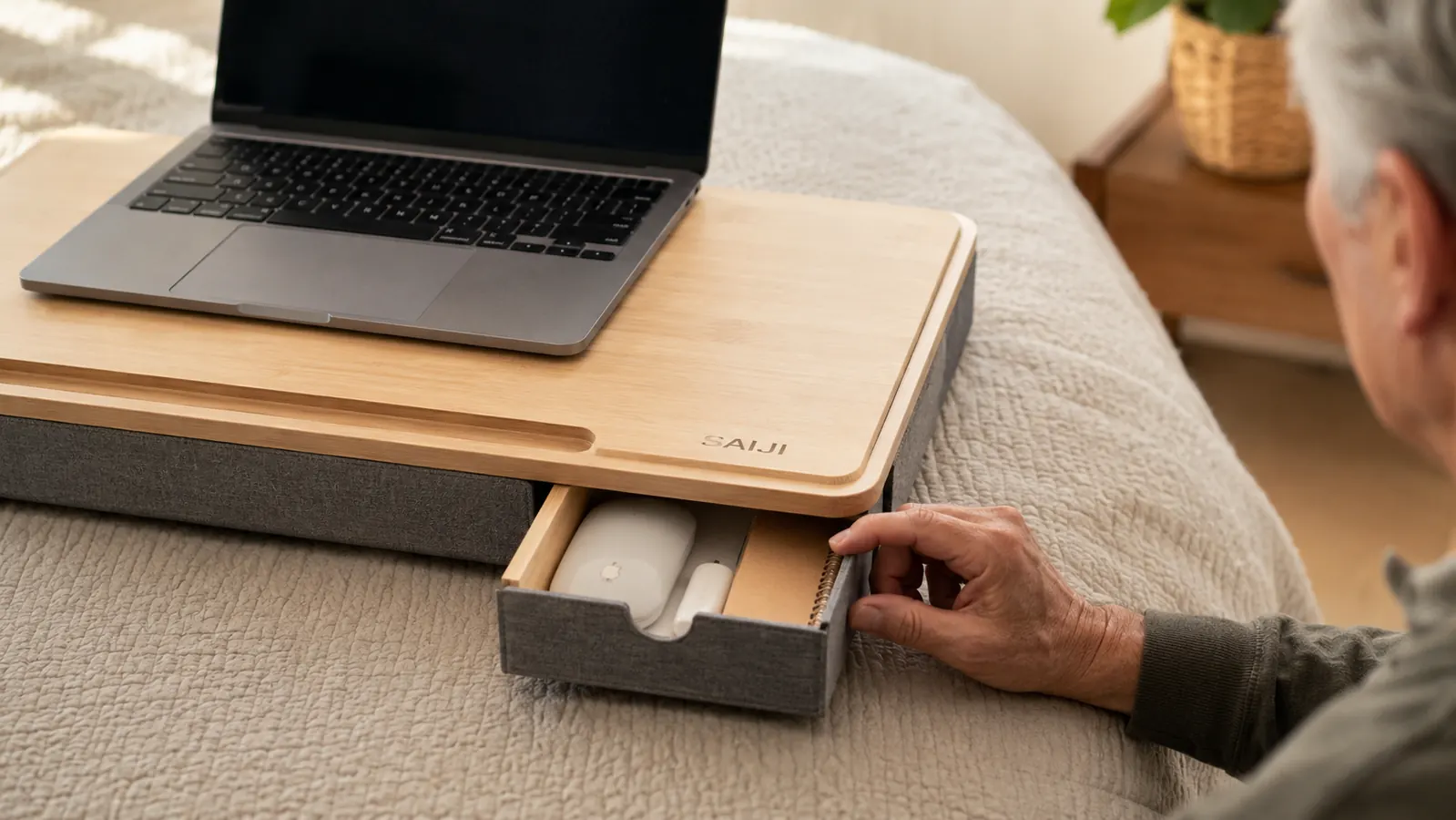
The lap desk wins the moment your desk chair isn't where you actually want to be. I work from an actual desk most of the day, but by four or five in the afternoon my back is done sitting upright, and I want to answer the last few emails from the couch with my feet up. A laptop stand is useless there. It needs a hard, level surface underneath it, and a couch cushion or a comforter doesn't qualify, the legs sink in unevenly and the whole thing tips the second you type. The SAIJI lap desk was built for exactly that situation. It has a padded underside that conforms to your lap or a couch cushion instead of fighting it, and a flat top wide enough that the laptop doesn't creep toward one edge every time I shift position.
The small drawer turned out to be more useful than I expected going in. I keep a wireless mouse, a pen, and a notepad in it, so when I move from the desk to the couch I'm not hunting around for a mouse that rolled under a cushion or a charger cable that's tangled up in a blanket. It's a small detail, but it's the kind of thing that makes a lap desk feel like a real workstation instead of just a board you balance a laptop on. The SAIJI also has enough clearance under the laptop that it doesn't trap heat against your legs the way a laptop sitting bare on a blanket does, which matters more than people expect after an hour of use, especially in warmer months.
There's also a practical safety angle that doesn't come up until you've lived with it. Setting a warm laptop directly on your lap for an hour or more isn't great, and setting one directly on a comforter is worse, because the fabric blocks the vents underneath and the whole machine runs hotter than it should. A raised, vented surface between the laptop and your legs fixes both problems at once. I didn't think about this until I noticed my old routine, laptop straight on a pillow in bed, left the machine noticeably warmer to the touch than the same session on the SAIJI.
The SAIJI is sized to fit up to a 17 inch laptop, and mine, a 15 inch model, has plenty of room left over on the tray for a notepad or a phone. It's not adjustable in height the way a fancier standing lap desk might be, and I want to be upfront about that limitation rather than oversell it. What it does well is stay flat, stay steady, and give the laptop somewhere solid to sit that isn't your actual lap. If you're carrying a heavier gaming laptop, check the weight rating first, but for a typical work laptop it hasn't budged or creaked once in months of daily use.
Where the Laptop Stand Wins
The laptop stand wins clearly once you're actually sitting at a desk with a keyboard and mouse already set up. Raising the screen four to six inches puts it closer to eye level, and that's the single biggest posture fix you can make for the hours you spend looking at a screen. A lap desk sits flat, so the laptop's built-in screen stays at the same low angle it always is, which is fine for a couch session but not ideal for a full workday spent looking down and forward at once. If most of your hours happen at one fixed desk with an external keyboard nearby, a stand is doing a job the lap desk simply isn't designed for.
It also wins on simplicity and cost. A basic laptop stand is a small, light piece of metal or plastic with almost nothing that can go wrong with it. There's no drawer to eventually stick, no padded underside to wear out, no hinge to loosen over time. If your only goal is lifting a laptop screen a few inches on a desk you already have, spending extra for a lap desk with storage you won't use at a desk is money you don't need to spend. A stand also tucks away easily when you're done, folding flat enough to slide into a drawer or a laptop bag pocket.
I'll also say this plainly, because most comparisons skip it: a stand alone doesn't fix posture by itself. Once you raise the screen, your hands are typing on a laptop keyboard that's now too high to be comfortable, which is why most people who take a stand seriously eventually add a separate keyboard and mouse. That's not a knock against the stand, it's just the honest next step, and it's worth knowing before you buy so you're not surprised later.
Working from the couch more than your desk chair? This is built for that, not the stand.
If your real problem is a laptop sliding around on your lap or overheating against a blanket, the SAIJI lap desk solves that specific issue, drawer included. It's not trying to replace your desk setup, it's built for everywhere else you actually sit.
Amazon Check Today's Price on Amazon →The SAIJI lap desk never asked me to sit up straight at a desk. It just made the couch a place I could actually work from without my laptop sliding off my knees.

Who Should Buy Which
If a meaningful chunk of your workday happens away from a proper desk, on a couch, in bed some mornings, in a recliner while you catch up on email, the SAIJI lap desk is the better buy and it's the one I'd point almost anyone toward first. It matches how the discomfort actually happens, a laptop with nowhere stable to sit, rather than assuming you're already parked at a desk. This is especially true if you're newly working from home and haven't committed to a full desk setup yet, or if you split your day between a desk and softer furniture depending on your energy or your back. If you're strictly a desk-and-chair worker with a keyboard and mouse already set up, and the only thing bothering you is a laptop screen sitting too low, a laptop stand is the cheaper and more direct fix for that specific problem.
If you're new to working from home, or you've been burned before by a gadget that promised to fix everything and did nothing, I get the hesitation. Neither of these products is a miracle. A lap desk won't fix a bad chair, and a stand won't fix a couch that isn't built for sitting upright for hours. What each one does is solve one specific, physical problem, a laptop with nowhere stable to rest, or a screen sitting too low, and that's a modest, honest claim I'm comfortable standing behind because it's exactly what happened when I tested them.
Some people end up with both, a stand at the desk for the bulk of the day and the SAIJI lap desk for the hour or two spent somewhere softer. That's not overbuying, it's matching the tool to the surface. Neither one is the wrong purchase. They just answer different questions about where you're actually sitting when you work, and that's worth being honest with yourself about before you buy either one. Think back over the last week and count how many hours you spent at a hard desk versus somewhere softer. That number, more than any spec sheet, tells you which one earns a spot in your home office first.
If your couch is your second desk, treat it like one.
The SAIJI lap desk has held up through months of couch sessions, morning coffee on the flat edge, and a mouse tucked in the drawer instead of lost in the cushions. It's a small change that made working off the couch feel intentional instead of improvised.
Amazon Check Today's Price on Amazon →